
Ranges
Mon Apr 21 2025Orchestration and Arranging Wiki
Brass
Trumpet
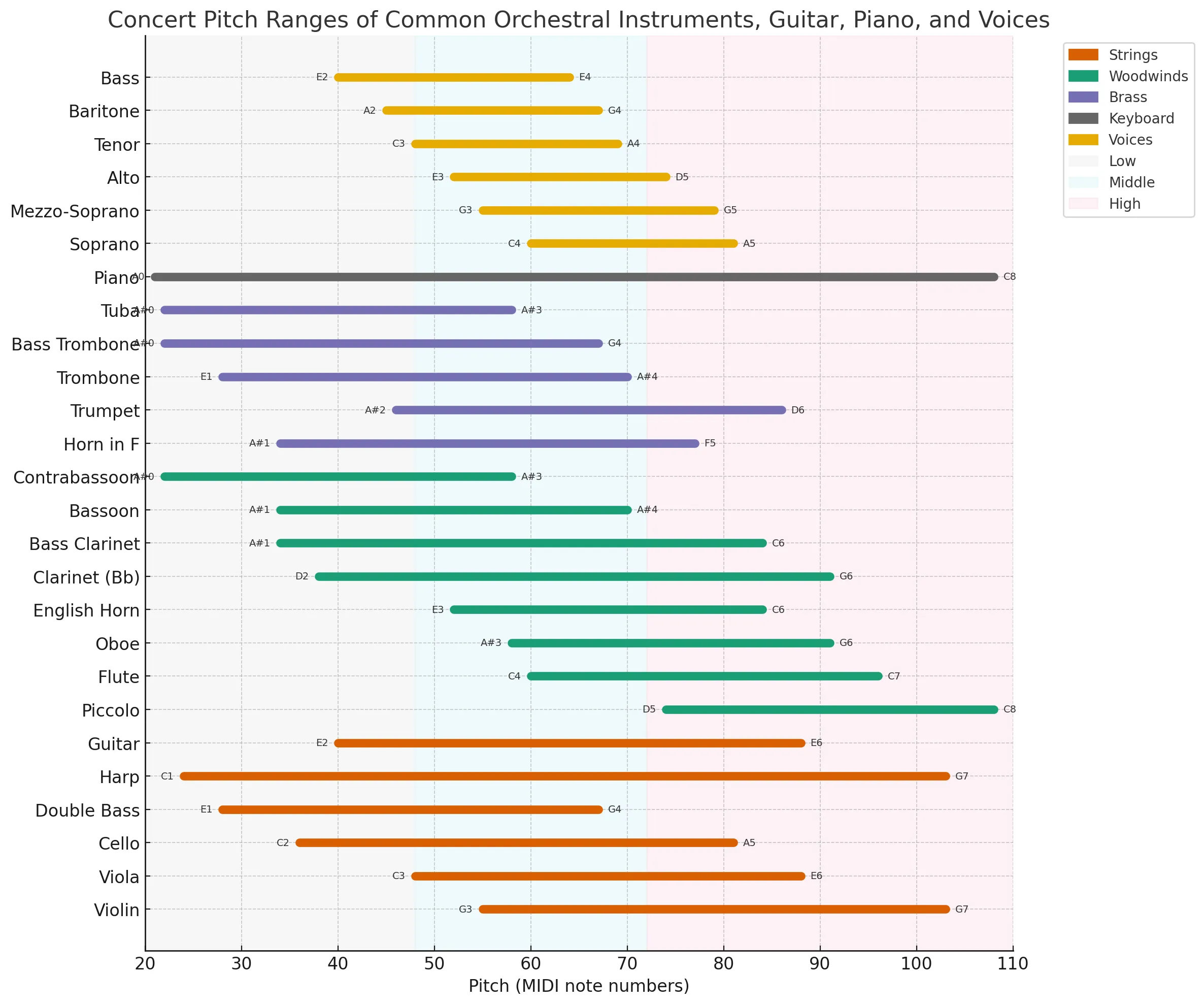
The standard trumpet range extends from the written F♯ immediately below Middle C up to about three octaves higher. Traditional trumpet repertoire rarely calls for notes beyond this range, and the fingering tables of most method books peak at the high C, two octaves above middle C.
Roughly, middle C to two octaves above.
Trombone
Trombone Range & Registers
| Register | Range (concert pitch) | Usage | Timbre |
|---|---|---|---|
| Pedal | E₁–B♭₁ | Special effects, jazz growls, comedic gliss; orchestral/big band depth with bass trombone | Huge, diffuse, rumbling |
| Low | E₂–B♭₂ | Orchestral bass lines, rich chorales, doubling cellos/basses/tuba | Warm, round, weighty |
| Middle | B–B♭₃ | Core melodic range, section harmonies, unisons with saxes/horns/cellos | Rich, vocal, flexible |
| Upper | B–F₄ | Lead lines, fanfares, bright accents in horn sections | Bright, cutting, brilliant |
| Extreme | G₄–D₅+ | Soloistic, trumpet-like effects | Piercing, demanding |
Register Use Comparisons
| Instrument | Low Reg. (tbn E₂–B♭₂) | Middle (B–B♭₃) | Upper (B–F₄) | Extreme (G₄+) |
|---|---|---|---|---|
| Trumpet | Doesn’t reach trombone low register | Trumpet’s low/mid overlaps here; trombone richer, more body | Overlaps trumpet’s low-high; trumpet still brighter | Trumpet extends far higher |
| Alto Sax | Alto’s low ≈ trombone’s mid-low | Blends well; both can be lyrical | Alto upper is brighter, reedier | Alto extends higher |
| Tenor Sax | Tenor low overlaps tbn low-mid; both warm | Strong unison match in middle | Trombone upper brighter/more metallic | Tenor higher, but not as piercing as trumpet |
| Cello | Cello low extends below; strong blend with tbn low | Middle range blends beautifully for lyric work | Trombone upper more forceful | Cello extends higher but stays warm |
| Viola | Doesn’t reach tbn low | Good overlap in mid/upper tbn | Viola’s high is sweeter, tbn’s high is brilliant | Viola extends far higher |
| Violin | No overlap in low | Overlaps tbn high only | Violin far more agile | Violin extreme is in another world |
| Voice (Bass) | Bass low overlaps tbn low | Mid-range similar warmth; trombone sustains better | Bass voice fades here, tbn projects easily | Bass voice rarely goes here |
| Piano | Piano covers all ranges; low register matches tbn pedal in depth | Mid blends well for chord voicings | Upper tbn cuts more in ensemble | Piano extends far higher, cleaner attack |
Functional Uses Across Ensemble
Pedal & Low (E₁–B♭₂)
-
Trombone: Bass reinforcement, dramatic swells, comedic or menacing special effects.
-
Compared to others: Only bass trombone, tuba, piano’s low octaves, cello/bass strings, and bass voice reach here; trumpet and altos absent.
Middle (B–B♭₃)
-
Trombone: Most versatile zone — melodies, counterlines, harmony support.
-
Compared to others: Overlaps comfortably with tenor sax mid, cello mid, viola low, bass voice mid, and trumpet low. Good blend zone.
Upper (B–F₄)
-
Trombone: Fanfare, lead lines, cutting stabs.
-
Compared to others: This is trumpet’s mid-high sweet spot, alto sax mid-high, violin mid, piano mid-high; bass voice largely absent.
Extreme (G₄–D₅+)
-
Trombone: Virtuoso, showpiece zone.
-
Compared to others: In trumpet’s middle-high range (still brighter), sax’s upper altissimo, violin/viola normal high register, piano’s high treble.
Woodwinds
Saxophone
Soprano
A transposing instrument pitched in the key of B♭, modern soprano saxophones with a high F# key have a range from A♭3 to E6 and are therefore pitched one octave above the tenor saxophone. Some saxophones have additional keys, allowing them to play an additional F♯ and G at the top of the range. These extra keys are commonly found on more modern saxophones. Additionally, skilled players can make use of the Altissimo register, which allows them to play even higher. There is also a soprano pitched in C, which is less common and has not been made since around 1940.
Alto
The range of the alto saxophone is from concert D♭3 (the D♭ below middle C—see Scientific pitch notation) to concert A♭5 (or A5 on altos with a high F♯ key). As with most types of saxophones, the standard written range is B♭3 to F6 (or F♯6). Above that, the altissimo register begins at F♯ and extends upwards. The saxophone’s altissimo register is more difficult to control than that of other woodwinds and is usually only expected from advanced players.
Roughly, bb 10th below middle C, F 2 octaves above middle C
Tenor
Tenor Sax Range & Registers
| Register | Range (concert pitch) | Usage | Timbre |
|---|---|---|---|
| Low | A♭₂–C₃ | Warm, breathy, lush; ballads, low riffs, bass line doubling | Round, dark, resonant |
| Middle | C♯₃–G₃ | Core melodic and harmonic zone; section blends | Warm with edge |
| Upper | G♯₃–E₄ | Brighter, projects for leads, cutting solos | Clear, assertive |
| High | F₄–E₅ | Brilliant solos, altissimo passages in jazz, funk, and avant-garde | Bright, piercing, reedy |
| Altissimo | F₅+ | Extended techniques, effects | Edgy, overtone-rich |
Register Use Comparisons
| Instrument | Sax Low (A♭₂–C₃) | Sax Mid (C♯₃–G₃) | Sax Upper (G♯₃–E₄) | Sax High (F₄+) |
|---|---|---|---|---|
| Trombone | Overlaps tbn low-mid; tbn bigger, brassier | Perfect mid blend; tbn more metallic | Trombone upper = sax upper; tbn more brilliance | Trombone high overlaps, but sax altissimo exceeds tbn extreme |
| Trumpet | Trumpet doesn’t reach sax low | Trumpet’s low overlaps sax middle; brighter timbre | Trumpet upper overlaps sax upper; trumpet sharper | Trumpet extreme range higher, brighter |
| Alto Sax | Alto low ≈ sax mid-low; brighter | Alto mid overlaps sax upper | Alto high above tenor | Alto altissimo far above tenor |
| Cello | Cello low matches sax low; richer, sustained | Cello mid blends with sax mid | Cello high is sweeter than sax upper | Cello goes higher with warm timbre |
| Viola | Viola low ≈ sax mid | Viola mid ≈ sax upper | Viola high beyond sax high | Viola extreme higher |
| Violin | No overlap in low | Overlaps sax upper | Violin high beyond sax high | Violin extreme far higher |
| Voice (Bass) | Bass low overlaps sax low; similar warmth | Bass mid matches sax mid | Bass upper less powerful | Bass voice rarely reaches sax high |
| Piano | Piano low octaves overlap sax low | Piano mid blends with sax mid | Piano upper matches sax upper in pitch | Piano extreme extends far higher |
Functional Uses Across Ensemble
Low (A♭₂–C₃)
-
Sax: Foundation in sax soli, doubling bass/bari sax lines, warm solo ballads.
-
Compared: Matches cello low, trombone low-mid, bass voice low. Trumpet absent here.
Middle (C♯₃–G₃)
-
Sax: Core melodic zone; most comfortable for phrasing and blending in section harmonies.
-
Compared: Matches trombone mid, trumpet low, cello mid, viola low, bass voice mid.
Upper (G♯₃–E₄)
-
Sax: Lead passages, brighter jazz lines, classical section clarity.
-
Compared: Matches trombone upper, trumpet mid-high, alto sax mid, violin mid.
High / Altissimo (F₄+)
-
Sax: Soloistic fireworks, funk/rock screaming lines, extended effects.
-
Compared: Trombone extreme, trumpet upper range, violin high register, piano treble.
Baritone
From concert D♭2 (Sometimes C2) to A♭4. Many models have a key for a (written) low A (instead of the usual low B♭) and/or a key for high F♯.